



Sports Medicine in Berlin
Examination and treatment of injuries, overuse and pain from sports
- Evaluation of acute and recurring sports injuries
- Treatment of complaints in the knee, shoulder, foot, elbow and muscles
- Sports medicine care by specialists in orthopedics and trauma surgery
Sports injuries are not always caused by a clear accident. Sometimes it is a fall, a rolled ankle or an awkward twisting movement. Often, however, complaints develop gradually: through repetitive strain, increasing training too quickly, muscular imbalances or movement patterns that continuously irritate joints, tendons and muscles.
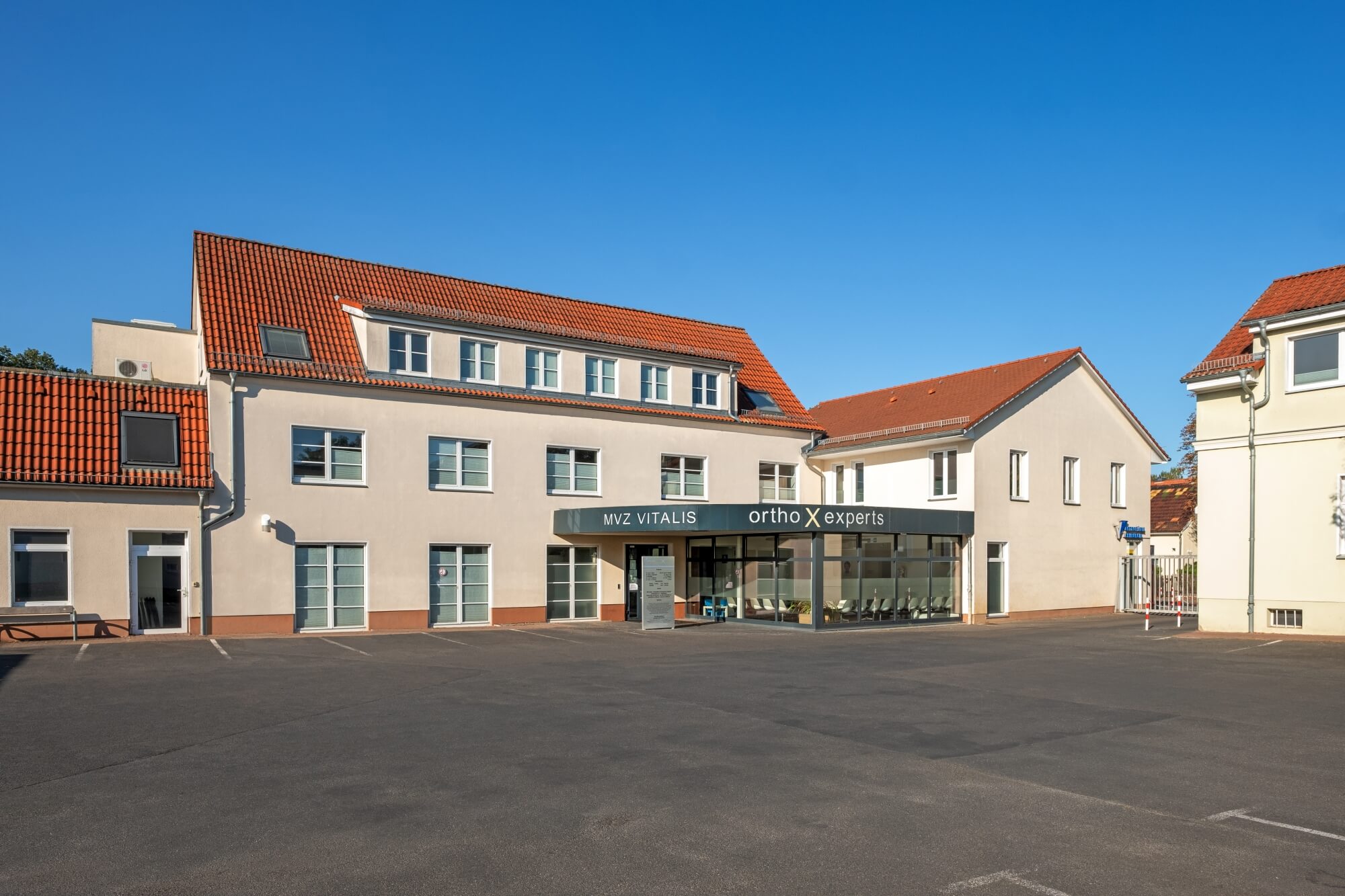
At MVZ VITALIS in Berlin-Buckow, we examine and treat acute injuries and overuse complaints of the musculoskeletal system. These include sports injuries to the knee, shoulder, foot, ankle, elbow, hand, back and muscles. The goal is to identify the cause of the complaints, treat the affected structure in a targeted way and plan a sensible return to exercise, training or sports.
Diagnostics: assessing sports injuries correctly
Treatment starts with an accurate diagnosis. Especially with sports-related complaints, it is important to know whether there is an acute injury or whether tendons, muscles, ligaments or joints have been irritated by repetitive strain. This determines whether rest, targeted therapy, load adjustment or further evaluation is needed first.
Our specialists assess mobility, stability, strength, pain points and load capacity of the affected area. If needed, imaging such as ultrasound, X-ray or MRI is added. This makes it easier to determine whether ligaments, tendons, cartilage, bones or muscles are affected, for example.
Based on the examination, we discuss with you which treatment makes sense and when a return to activity seems realistic. This is not only about being pain-free, but also about stability, function and the risk of recurring complaints.
Common sports injuries and sports-related complaints
Sports-related complaints can vary greatly depending on the sport and the type of strain. The knee, shoulder, elbow, foot and muscles are frequently affected. At our practice, we treat the following injuries and conditions, among others:
A cruciate ligament tear is often caused by a twisting movement of the knee, for example in soccer, handball, skiing or other sports with rapid changes of direction. Typical signs are pain, swelling, instability and the feeling that you can no longer rely on your knee.
The meniscus can be damaged by twisting movements, falls or repetitive strain. Symptoms often include knee pain, swelling, a locking sensation or problems with weight bearing and bending.
The medial and lateral collateral ligaments stabilize the knee from the sides. After a collateral ligament injury, pain, swelling and a feeling of instability in the joint may occur. Whether conservative treatment is sufficient depends on the extent of the injury and the stability of the knee joint.
In a patellar dislocation, the kneecap slips out of its groove. After such an injury, it should be checked whether ligaments, cartilage or other structures have been damaged. Another important question is whether there is an increased risk of further dislocations.
Pain in the Achilles tendon is often caused by overuse, shortened muscles, changes in training or repeated irritation. With sudden, shooting pain, a partial or complete tear of the Achilles tendon must also be considered.
Muscle injuries often occur during sprinting, jumping or stop-and-go movements. A strain usually causes pain without major structural damage. With torn muscle fibers, individual muscle fibers are injured; this often results in significant pain, loss of strength and sometimes bleeding into the tissue.
The rotator cuff stabilizes and guides the shoulder joint. Injuries or tears can result from falls, overhead strain, sports or wear and tear. Typical signs are pain, loss of strength and difficulty lifting or rotating the arm.
In a shoulder dislocation, the head of the upper arm bone slips out of the socket. This often happens during falls or contact sports. Afterwards, a careful examination should determine whether the labrum, capsule, ligaments or bones were also injured.
The labrum of the shoulder can be injured by falls, overhead strain or after a shoulder dislocation. A SLAP lesion affects the upper part of the labrum, where the long biceps tendon attaches. Possible symptoms include pain, snapping, loss of strength or a feeling of instability.
Tennis elbow and golfer's elbow are irritations of the tendon attachments at the elbow. They occur not only in tennis or golf, but also with strength training, climbing, manual work or repetitive gripping and twisting movements.
Skier's thumb is an injury to a collateral ligament at the base joint of the thumb. It often happens during falls, for example while skiing or playing ball sports. The consequences can be pain, swelling and instability when gripping.
In osteochondritis dissecans, a localized area of cartilage and bone is damaged, for example in the knee or ankle. Depending on the stage, pain, swelling, locking or loose bodies in the joint may occur.
IT band syndrome causes pain on the outer side of the knee. Runners are frequently affected. The cause is usually irritation from repetitive strain in the area of the outer knee joint.
Conservative and surgical treatment in sports medicine
Many sports injuries can be treated conservatively. Depending on the diagnosis, this may include offloading, physical therapy, physical medicine, kinesio taping, shockwave therapy, injections, training recommendations or a gradual increase in load.
For certain injuries, surgery may be advisable or necessary. This applies, for example, to pronounced instability, certain cruciate ligament tears, meniscus damage, shoulder instability, tendon ruptures or loose bodies in the joint. Whether surgery is an option is carefully weighed after the examination and imaging.
Back to everyday life, training and sports
After a sports injury, managing the load correctly is crucial. Returning too early risks persistent complaints or a new injury. Resting for too long, on the other hand, can reduce strength, mobility and coordination.
That is why we discuss with you which level of activity makes sense at which point. Depending on the injury, the focus is first on pain reduction and mobility, and later on strength, stability, coordination and sport-specific load. The return to sports should match the diagnosis, your fitness level and your personal goal.
Sports medicine for recreational and competitive athletes
Sports medicine is not only relevant for competitive sports. Recreational athletes, adolescents, active adults and people who want to start exercising again after a break also benefit from a targeted orthopedic evaluation.
At MVZ VITALIS, we treat sports-related complaints with a view to the specific sport, activity level and long-term load capacity. It is not just about treating every complaint immediately and to the maximum. What matters is a realistic assessment: What is harmless? What needs rest? What should be treated specifically? And when is it sensible to return to sports?
Book an appointment for sports medicine now
Have you been injured during sports, or do you have recurring pain during training or complaints after exercise? Then feel free to book an appointment at MVZ VITALIS, Center for Orthopedics and Pain Therapy in Berlin-Buckow.
Our specialists will be happy to advise you on which sports medicine treatment is suitable for your complaints and how to gradually build up your load again.